Tell us about the job
Takes about a minute. No obligation.
A furnace failing in Fayette County is almost never a weather story. 36 severe weather events were recorded in Fayette County, Illinois between 2015 and 2024. At that rate, severe weather is an occasional event here, not a standing condition, and a contractor working through a diagnosis will spend most of their time on the equipment itself: how old the heat exchanger is, whether the original install gave the unit adequate airflow, and how regularly filters and components have been serviced. A system that has been neglected for years does not need a bad storm season to explain a cracked component or a failed igniter.
Furnaces installed in houses this old have often been replaced once or twice already, which means what sits in the utility room today is not what the house was built for. Half the homes in Fayette County, Illinois were built in 1972 or earlier (2020-2024 ACS 5-year). When a contractor opens a furnace here, the question that shapes the repair bill is whether the heat exchanger, control board, or burner assembly it takes are still in production. A manufacturer may have discontinued a part line entirely, and the next available component requires modifications the original cabinet was not built to accept. That gap between what the system needs and what the supply chain currently carries is where furnace repair in this county gets complicated.
The Parts of a Furnace a Contractor Checks First
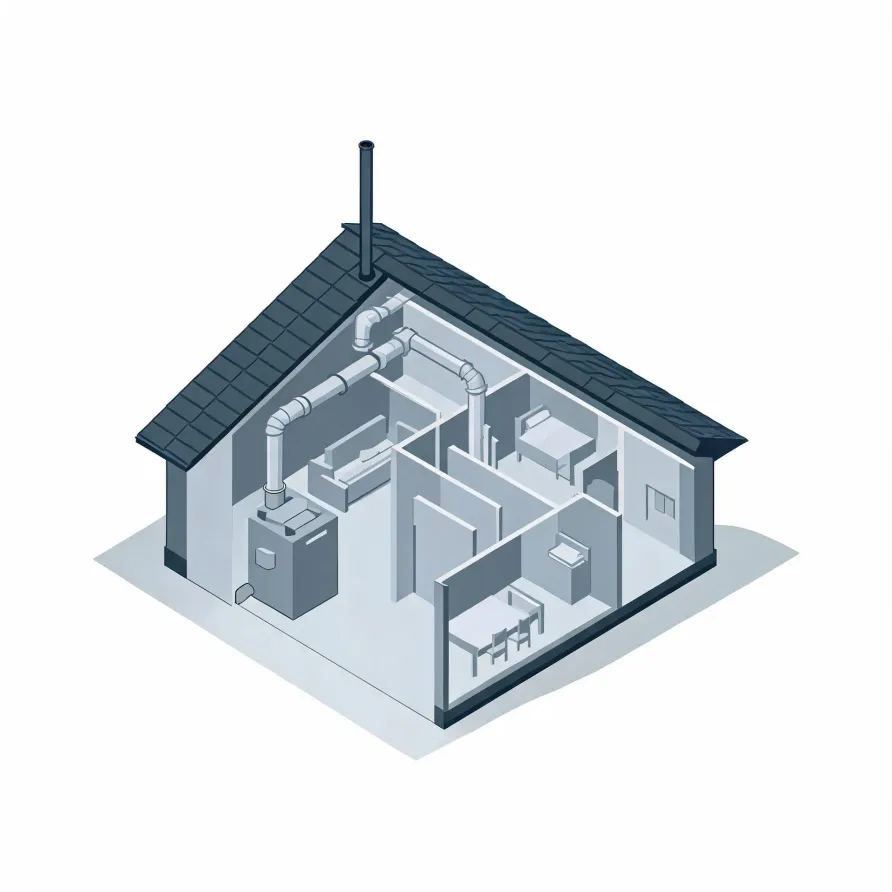
The furnace itself sits in a mechanical room, basement, or utility closet and is the piece a contractor opens first. Inside it, the heat exchanger does the actual work of warming air, and a cracked or corroded exchanger is one of the most serious findings a repair visit can turn up. The burner assembly, which sits just below the exchanger, is another early stop.
The blower motor pulls air through the cabinet and pushes it into the supply side of the house. It runs on a capacitor that fails on its own schedule, and that capacitor is a common reason a furnace stops moving air even when the burner lights fine. The igniter, the flame sensor, and the control board round out the pieces a contractor traces when the system short-cycles or refuses to start.
The drawing shows a typical furnace layout, and a licensed contractor determines which components apply to the specific equipment and configuration in your home.
Get matched in Fayette CountyFayette County, by the numbers
36 severe weather events were recorded in Fayette County, Illinois between 2015 and 2024.
NOAA National Centers for Environmental Information, Storm Events Database, bulk CSV export, events 2015-01-01 through 2024-12-31.Half the homes in Fayette County, Illinois were built in 1972 or earlier (2020-2024 ACS 5-year).
U.S. Census Bureau, 2020-2024 American Community Survey 5-Year EstimatesFayette County, Illinois holds 8,808 housing units (2020-2024 ACS 5-year).
U.S. Census Bureau, 2020-2024 American Community Survey 5-Year EstimatesOwners occupy 80.6% of the occupied homes in Fayette County, Illinois (2020-2024 ACS 5-year).
U.S. Census Bureau, 2020-2024 American Community Survey 5-Year EstimatesCodes & Standards Covering Furnace Repair in Fayette County, Illinois5 sourced rules and standards
What the Repair Visit Looks Like
Non-weatherized gas furnaces manufactured on or after November 19, 2015 must reach 80.0 percent AFUE.
Non-weatherized oil-fired furnaces manufactured on or after November 19, 2015 must reach 83.0 percent AFUE.
Mobile home gas furnaces manufactured on or after November 19, 2015 must reach 80.0 percent AFUE.
Non-weatherized gas furnaces manufactured on or after December 18, 2028 must reach 95.0 percent AFUE, up from the 80.0 percent minimum that applies to units manufactured before that date.
Licensing Rules for HVAC Work in Fayette County, Illinois
Illinois leaves HVAC licensing to the municipality: state law lets the corporate authorities of each city or village examine, license and regulate heating, air conditioning and refrigeration contractors, and caps the licence fee they may charge at $50 — so who licenses you depends on the town you work in.
Severe Weather Events in Fayette County
Weather swings put real strain on furnaces, and Fayette County has its own pattern of what the sky delivers across a year. A furnace that absorbs that load without a service visit will show it eventually, which is why local repair contractors track conditions here rather than work from a national average.
36 severe weather events, 2015–2024. Source: NOAA National Centers for Environmental Information, Storm Events Database.