Tell us about the job
Takes about a minute. No obligation.
A furnace repair in Adams County starts with the system itself: how old the heat exchanger is, whether filters have been changed, whether the igniter or limit switch has been serviced. 95 severe weather events were recorded in Adams County, Illinois between 2015 and 2024. That puts severe weather squarely in the middle of the national range, which means a contractor diagnosing a failed furnace here looks at worn components and deferred maintenance before anything else. A blower motor that quit after years of dusty winters is not a weather story. A cracked heat exchanger on an aging unit is not one either.
Furnaces sitting in houses built for an earlier era of heating tend to run on components that manufacturers have cycled out. Half the homes in Adams County, Illinois were built in 1965 or earlier (2020-2024 ACS 5-year). A contractor opening a failed heat exchanger or a worn inducer assembly here has to check whether the part it takes is still in production before the repair scope means anything. If it is not, the job changes shape entirely, and what looked like a straightforward repair becomes a conversation about what can be sourced and what cannot.
The Parts of a Furnace a Contractor Checks First
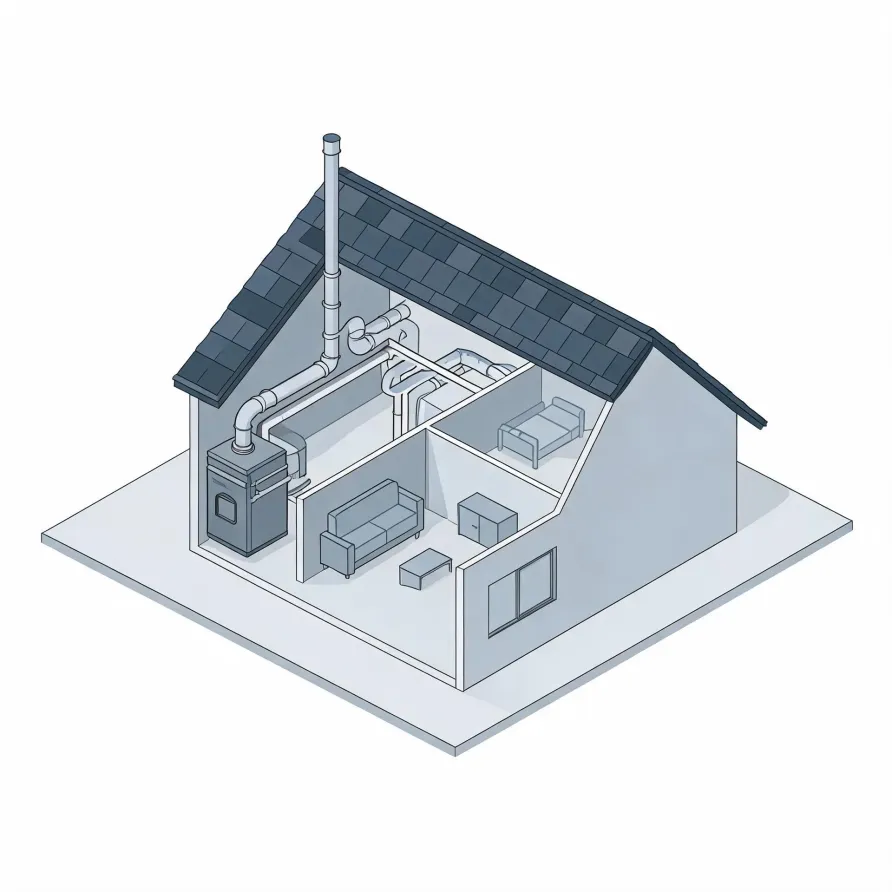
The furnace itself sits in the basement, utility room, or closet and is the piece a contractor opens first. Inside it, the heat exchanger is the part most worth understanding: cracks or failures there are what stop a furnace from running safely. The burners, which sit just below it, are where ignition problems and flame irregularities show up.
The blower motor sits at the base of the furnace cabinet and pushes conditioned air into the supply plenum. The flue pipe runs from the top of the unit out through the wall or roof and is checked when combustion problems or pressure faults point toward a venting issue. The thermostat, on an interior wall, is where a contractor rules out a controls problem before opening the cabinet.
The drawing shows the general layout of a furnace system, and a licensed contractor determines which components apply to the specific setup in your home.
Get matched in Adams CountyAdams County, by the numbers
95 severe weather events were recorded in Adams County, Illinois between 2015 and 2024.
NOAA National Centers for Environmental Information, Storm Events Database, bulk CSV export, events 2015-01-01 through 2024-12-31.Half the homes in Adams County, Illinois were built in 1965 or earlier (2020-2024 ACS 5-year).
U.S. Census Bureau, 2020-2024 American Community Survey 5-Year EstimatesAdams County, Illinois holds 30,302 housing units (2020-2024 ACS 5-year).
U.S. Census Bureau, 2020-2024 American Community Survey 5-Year EstimatesOwners occupy 72.1% of the occupied homes in Adams County, Illinois (2020-2024 ACS 5-year).
U.S. Census Bureau, 2020-2024 American Community Survey 5-Year EstimatesCodes & Standards Covering Furnace Repair in Adams County, Illinois5 sourced rules and standards
What Happens When the Contractor Arrives
Non-weatherized gas furnaces manufactured on or after November 19, 2015 must reach 80.0 percent AFUE.
Non-weatherized oil-fired furnaces manufactured on or after November 19, 2015 must reach 83.0 percent AFUE.
Mobile home gas furnaces manufactured on or after November 19, 2015 must reach 80.0 percent AFUE.
Non-weatherized gas furnaces manufactured on or after December 18, 2028 must reach 95.0 percent AFUE, up from the 80.0 percent minimum that applies to units manufactured before that date.
Licensing and Legal Requirements in Adams County, Illinois
Illinois leaves HVAC licensing to the municipality: state law lets the corporate authorities of each city or village examine, license and regulate heating, air conditioning and refrigeration contractors, and caps the licence fee they may charge at $50 — so who licenses you depends on the town you work in.
Severe Weather Events in Adams County
Extreme weather puts real stress on heating equipment: hard cold snaps, power fluctuations, and sudden temperature swings push furnaces to run harder and longer than they were built to handle on a given day. How often that happens in Adams County shapes how much wear local furnaces accumulate, which is why weather history belongs on a page about repair work here.
95 severe weather events, 2015–2024. Source: NOAA National Centers for Environmental Information, Storm Events Database.