Tell us about the job
Takes about a minute. No obligation.
A furnace that stops working in Monroe County has usually been let down by something closer to home than the weather. 71 severe weather events were recorded in Monroe County, Illinois between 2015 and 2024. At that rate, severe weather is an occasional event here, not a steady operating condition, and it carries little weight as a diagnosis. What a contractor finds inside a struggling furnace is more likely to reflect how old the equipment is, how well it was installed, and whether it has been serviced. Those three variables explain most of what goes wrong.
Furnace repair in a county where a large share of homes have been standing long enough to have housed more than one heating system runs into a specific problem: the parts the current unit takes. Half the homes in Monroe County, Illinois were built in 1990 or earlier (2020-2024 ACS 5-year). A furnace sitting in a house that age has often been a replacement itself, which puts the equipment in a range where some components are at the edge of what suppliers still stock. When a contractor opens the unit, the question is whether what failed can be sourced, or whether the repair turns into a longer conversation about what comes next.
The Parts of a Furnace a Contractor Checks First
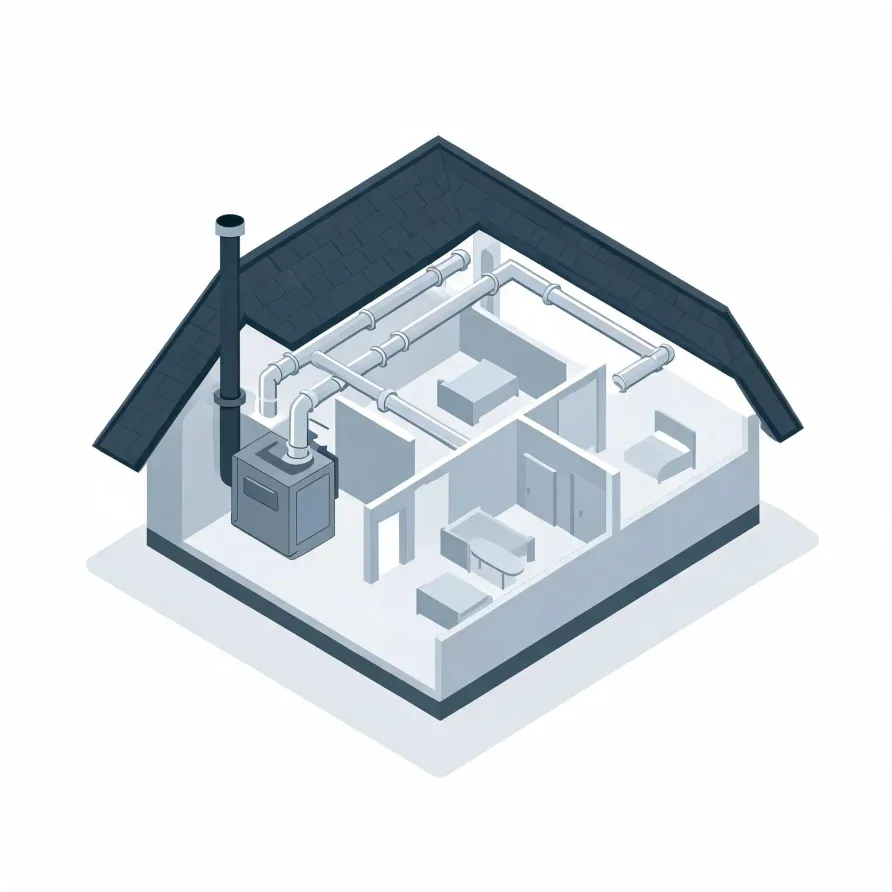
The furnace itself sits in the basement, utility room, or closet and is the piece a contractor goes to first. Inside it, the heat exchanger is the part that fails most often when the problem is heat: it pulls combustion gases away from the air your home breathes. The burners, which ignite the fuel, are another early stop.
The blower motor sits inside the furnace cabinet and pushes conditioned air into the supply side of the house. The flue pipe runs from the cabinet to an exterior wall or roofline and carries exhaust out. A contractor also checks the igniter and the flame sensor, both small components that sit near the burners and are common sources of a furnace that starts then shuts off.
The drawing shows a general layout of these components, and a licensed contractor determines what applies to your specific system and installation.
Get matched in Monroe CountyMonroe County, Illinois, by the numbers
71 severe weather events were recorded in Monroe County, Illinois between 2015 and 2024.
NOAA National Centers for Environmental Information, Storm Events Database, bulk CSV export, events 2015-01-01 through 2024-12-31.Half the homes in Monroe County, Illinois were built in 1990 or earlier (2020-2024 ACS 5-year).
U.S. Census Bureau, 2020-2024 American Community Survey 5-Year EstimatesMonroe County, Illinois holds 14,759 housing units (2020-2024 ACS 5-year).
U.S. Census Bureau, 2020-2024 American Community Survey 5-Year EstimatesOwners occupy 84.7% of the occupied homes in Monroe County, Illinois (2020-2024 ACS 5-year).
U.S. Census Bureau, 2020-2024 American Community Survey 5-Year EstimatesCodes & Standards Covering Furnace Repair in Monroe County, Illinois5 sourced rules and standards
What the Repair Visit Looks Like
Non-weatherized gas furnaces manufactured on or after November 19, 2015 must reach 80.0 percent AFUE.
Non-weatherized oil-fired furnaces manufactured on or after November 19, 2015 must reach 83.0 percent AFUE.
Mobile home gas furnaces manufactured on or after November 19, 2015 must reach 80.0 percent AFUE.
Non-weatherized gas furnaces manufactured on or after December 18, 2028 must reach 95.0 percent AFUE, up from the 80.0 percent minimum that applies to units manufactured before that date.
Licensing and Legal Requirements in Monroe County, Illinois
Illinois leaves HVAC licensing to the municipality: state law lets the corporate authorities of each city or village examine, license and regulate heating, air conditioning and refrigeration contractors, and caps the licence fee they may charge at $50 — so who licenses you depends on the town you work in.
Severe Weather Events in Monroe County
Hard weather puts real stress on a furnace: pressure cycles, sudden demand spikes, and power fluctuations all add wear that accumulates over time. How much of that a system here has absorbed is shaped by local conditions, which is why the pattern for Monroe County matters when you are weighing repair decisions.
71 severe weather events, 2015–2024. Source: NOAA National Centers for Environmental Information, Storm Events Database.