Tell us about the job
Takes about a minute. No obligation.
A furnace installation in Boone County starts with the building, not the weather outside it. 84 severe weather events were recorded in Boone County, Illinois between 2015 and 2024. Severe weather at that frequency is real but not the dominant variable a contractor has to solve for. Insulation gaps, duct layout, and the heat loss through walls and windows are what drive the sizing decision here. A contractor who skips a manual load calculation and quotes from square footage alone will land on the wrong unit regardless of the season.
Ductwork laid in for an older generation of heating equipment carries assumptions about airflow, capacity, and routing that a new furnace will test immediately. Half the homes in Boone County, Illinois were built in 1986 or earlier (2020-2024 ACS 5-year). That means a contractor sizing a new furnace here is also checking whether what is already in the walls and floor can handle what the new unit will push through it. Where the ducts fall short, the installation scope grows. Where they hold, it does not.
What Gets Installed With a New Furnace
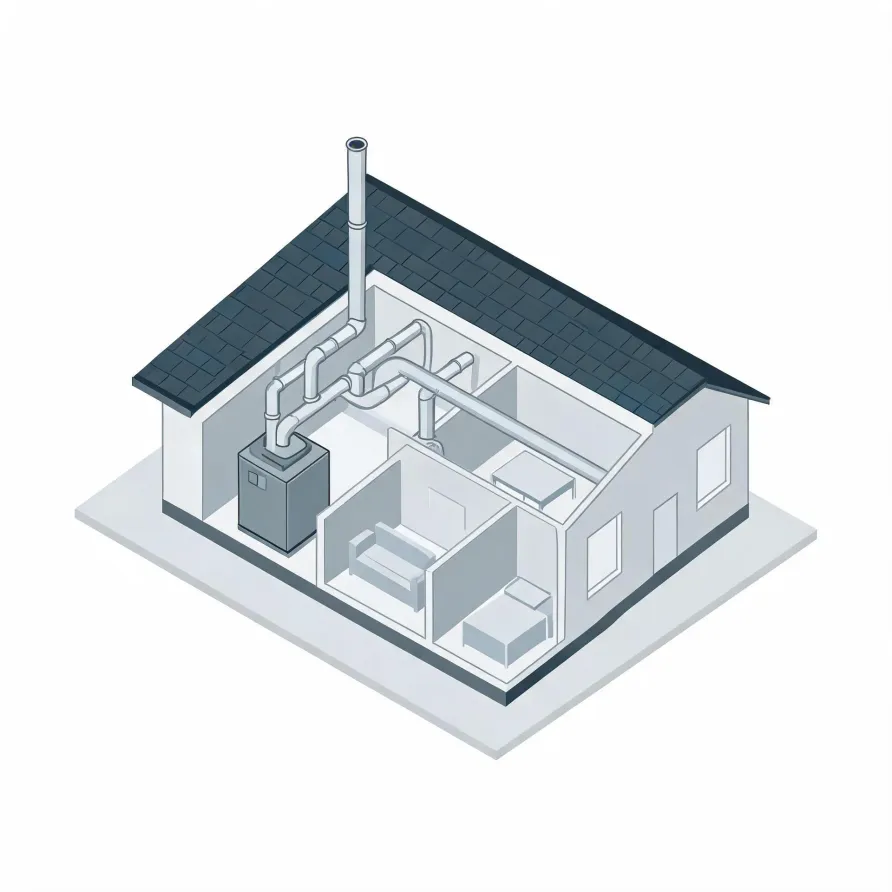
The furnace itself sits in a utility space, basement, or closet, and it is the unit that produces heat for the house. Attached to it is the heat exchanger, a metal chamber where combustion gases stay sealed off from the air that moves through your home. The burners and the blower motor live inside the cabinet as well, the burners generating heat and the blower pushing conditioned air out.
The flue pipe runs from the furnace to an exterior wall or up through the roof, carrying combustion exhaust out of the house. The thermostat mounts on an interior wall and gives you control over when the furnace runs. A filter housing sits at the air intake, and a gas supply line connects to the furnace from your home's existing gas service.
The drawing shows a typical layout, and a licensed contractor determines exactly what applies to your house and its setup.
Find a contractor in Boone CountyBoone County, by the numbers
84 severe weather events were recorded in Boone County, Illinois between 2015 and 2024.
NOAA National Centers for Environmental Information, Storm Events Database, bulk CSV export, events 2015-01-01 through 2024-12-31.Half the homes in Boone County, Illinois were built in 1986 or earlier (2020-2024 ACS 5-year).
U.S. Census Bureau, 2020-2024 American Community Survey 5-Year EstimatesBoone County, Illinois holds 20,291 housing units (2020-2024 ACS 5-year).
U.S. Census Bureau, 2020-2024 American Community Survey 5-Year EstimatesOwners occupy 81.8% of the occupied homes in Boone County, Illinois (2020-2024 ACS 5-year).
U.S. Census Bureau, 2020-2024 American Community Survey 5-Year EstimatesFurnace Installation Rules for Boone County, Illinois5 codes & standards
What the Installation Actually Looks Like
Non-weatherized gas furnaces manufactured on or after November 19, 2015 must reach 80.0 percent AFUE.
Non-weatherized oil-fired furnaces manufactured on or after November 19, 2015 must reach 83.0 percent AFUE.
Mobile home gas furnaces manufactured on or after November 19, 2015 must reach 80.0 percent AFUE.
Non-weatherized gas furnaces manufactured on or after December 18, 2028 must reach 95.0 percent AFUE, up from the 80.0 percent minimum that applies to units manufactured before that date.
Licensing and Legal Requirements in Boone County, Illinois
Illinois leaves HVAC licensing to the municipality: state law lets the corporate authorities of each city or village examine, license and regulate heating, air conditioning and refrigeration contractors, and caps the licence fee they may charge at $50 — so who licenses you depends on the town you work in.
Severe Weather Events in Boone County
Weather in this region puts real demands on heating equipment, from sustained cold that runs a furnace hard to sharp seasonal swings that accelerate wear. How often those conditions arrive is a local fact, and it shapes what a furnace installed here needs to handle.
84 severe weather events, 2015–2024. Source: NOAA National Centers for Environmental Information, Storm Events Database.